Format, use & care · 5 min read
Balm vs. salve vs. cream. What's the difference?
Same shelf, different stuff. The difference is mostly water, wax and how it feels going on. The Old Man explains, slowly.

November 12, 2026
My grandson asked me the other day what the difference is between a balm and a cream. I told him it's the same as the difference between butter and milk. He looked at me like I'd lost it. I hadn't. I was right, and I'll explain.
Walk down any aisle and you'll see balm, salve, cream, lotion, butter and ointment, sometimes on the same brand's shelf. They're not just fancy names. Each one is built differently, and you can feel it the second it hits your hand.
In this guide
The one thing that matters: water
Here's the whole story in one line. Creams and lotions have water in them. Balms and salves don't.
That one difference changes everything else:
- Texture. No water means a balm is firm in the jar. Water makes a cream soft and a lotion pourable.
- How it goes on. A balm melts with the warmth of your fingers and goes on rich and slow. A cream spreads fast and thin and disappears quicker.
- Preservatives. Where there's water, there's room for things to grow. That's why water-based products generally need a preservative system. A balm with no water is a much less friendly place for that.
- How much you use. A balm is concentrated. A little scoop goes a long way. With a lotion, you pump and pump.
That's the butter and milk thing. Butter is mostly fat. Milk is mostly water. Same cow, different results. I told him.
Each one, plainly
Balm
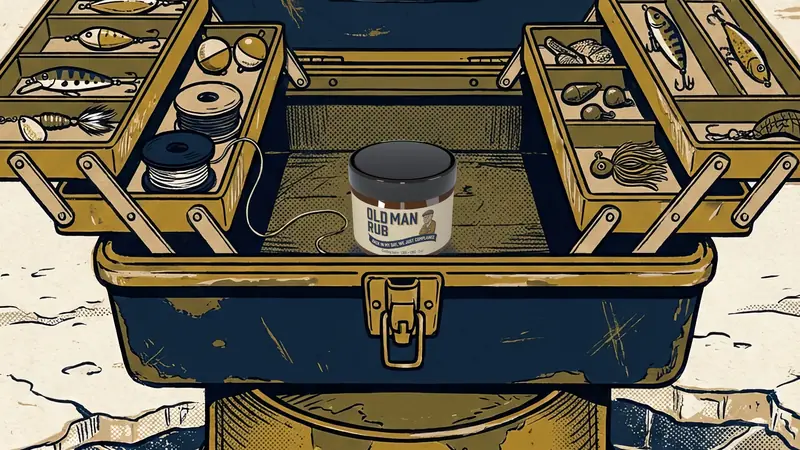
Oils, butters and wax, no water. Firm in the jar, softens when you rub it with a warm finger. Think of a lip balm, just in a bigger jar. Balms usually come in a tin or a jar, or a twist-up stick. This is what Old Man Rub is: a cooling balm with CBD + CBG in a 2 oz amber glass jar with a black lid.
Salve
The old-timer's word for nearly the same thing. A salve is also an oil-and-wax blend with no water. People often use "salve" for a softer blend with a little less wax, and "balm" for a firmer one. But there's no legal rule that sorts the two. Two brands can sell the same blend under different names. Read the ingredients, not the word on the front.
Cream
Oil and water mixed together and held that way by an emulsifier, the ingredient that keeps them from splitting apart like salad dressing. Thicker than a lotion, thinner than a balm. Usually comes in a tub or tube. Needs a preservative.
Lotion
A cream with even more water. Thin enough to pump. Goes on fast, soaks in fast, and you'll need more of it. Good for a big area like your arms or legs.
Body butter
Usually a whipped blend heavy on butters like shea or cocoa. Some have water, some don't. The name is marketing. The ingredient list tells the truth.
Ointment
Usually a greasy base like petrolatum. You'll see the word on a lot of drugstore products, and many of those are sold as over-the-counter drugs with a Drug Facts box. Different shelf, different rules.
Old Man Rub is a balm. No water, a little goes a long way, and the jar is built like his toolbox. Batch 001 is 500 jars. Get on the list for 15% off launch day →
How to tell from the label
You don't need a chemistry degree. You need your reading glasses, which are probably on your head.
- Flip it over. Cosmetics list every ingredient in order of how much is in there, heaviest first. That's a federal rule (21 CFR 701.3).
- Read the first ingredient. If it's water (sometimes written "aqua"), you're holding a cream or a lotion, whatever the front says. If it's an oil, a butter or a wax, it's a balm or salve.
- Look for a Drug Facts box. If there's one, the product is sold as an over-the-counter drug, not just a cosmetic. The FDA decides which is which by a product's intended use, and a Drug Facts box is how you can tell at a glance.
- Look for a batch number. Especially on anything with CBD or CBG. The batch number should match a lab report. I explain how to read one in the CBD + CBG explainer.
Which one to pick
This isn't about which one is "better." They're different tools, like a flathead and a Phillips.
- Want something rich that you use a little of? Balm.
- Want something light that soaks in fast over a big area? Lotion.
- Somewhere in between? Cream.
- Want a jar that sits on the workbench for months, lid on tight, and doesn't need babying? Balm. Keep it out of the sun and away from the kids, and follow the directions on the label.
Me, I'm a balm man. A jar, a lid and a small scoop. No pump that jams, no tube that cracks in the cold, no cap that falls behind the toilet. Save a jar from Batch 001. The list gets 15% off launch day.
The Old Man's last word
Water in it, cream. No water, balm. Read the back of the jar. That's the whole guide. The rest was me talking.
Questions people ask
What's the difference between a balm and a cream?
Water. A balm is made of oils, butters and wax with no water, so it's firm in the jar and melts on contact with warm skin. A cream is oil and water blended together, so it's softer, spreads thinner and usually needs a preservative.
Is a salve the same as a balm?
Close to it. Both are oil-and-wax blends with no water. "Salve" is the older word and often means a softer blend. There's no legal line between the two; read the ingredient list.
What is Old Man Rub?
A balm: a cooling balm with CBD + CBG in a 2 oz amber glass jar. Join the list for 15% off launch day.
How can I tell from the label?
Look at the first ingredient. Cosmetics list ingredients heaviest first. If water (often written "aqua") is first, it's a cream or lotion. If an oil, butter or wax is first, it's a balm or salve.
Clip & save · Batch 001
Save a jar.
You're on the list.
Your 15% comes launch day.
Sources
- U.S. FDA, Is It a Cosmetic, a Drug, or Both? (Or Is It Soap?). https://www.fda.gov/cosmetics/cosmetics-laws-regulations/it-cosmetic-drug-or-both-or-it-soap (checked 2026-11-10)
- eCFR, 21 CFR 701.3, Designation of ingredients (cosmetics). https://www.ecfr.gov/current/title-21/chapter-I/subchapter-G/part-701/subpart-A/section-701.3 (checked 2026-11-10)