Ingredients & feel · 5 min read
CBD and CBG, in plain English.
Two sets of letters on a jar. What they are, where they come from, what the law says about putting them in a balm, and how to read the lab report. No sales pitch.

November 12, 2026
The front of my jar says "CBD + CBG." People ask me what that means. Some of them ask nicely. Most of them ask the way I'd ask, which is "What's this alphabet soup?"
Fair question. Here's the plain answer, with sources at the bottom so you don't have to take an old man's word for it.
In this explainer
What they are
CBD is short for cannabidiol. CBG is short for cannabigerol. Both are cannabinoids, which is the family name for a group of compounds the hemp plant makes. There are more than a hundred of them. These two are among the best known.
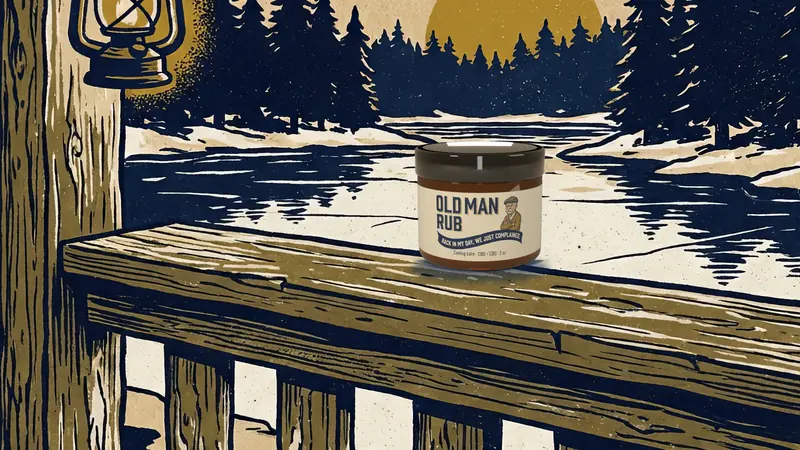
They come out of the plant as part of an extract. A maker takes that extract and blends it into a product. In our case, the product is a cooling balm in an amber glass jar.
Neither one is a new invention. They've been studied by chemists for decades, and both have public entries in PubChem, the NIH chemistry database, if you like reading that sort of thing. I do. I also read the warranty card on my snowblower.
How they're different
CBD and CBG are close cousins. Here's what you can check yourself:
- Formula: PubChem lists CBD as C21H30O2 and CBG as C21H32O2. Same number of carbons and oxygens. CBG has two more hydrogens.
- Shape: CBD has a closed ring on one end. CBG has an open chain where that ring would be. Chemists care a lot about shape. So does anyone who's tried to fit a metric bolt in an SAE nut.
- How much the plant makes: Most hemp grown for extract is bred to make lots of CBD. CBG usually shows up in smaller amounts, which is part of why it's less common on labels.
That's the honest difference. You'll find websites that go a lot further and tell you what each one does to you. I won't. More on that below.
Old Man Rub is a cooling balm with CBD + CBG. Batch 001 is 500 jars, and the lab report goes up with it. Get on the list for 15% off launch day →
What the law says about putting them in a balm
Here's where people get confused, and where a lot of brands get in trouble.
The FDA sorts by intended use
The FDA decides whether something is a drug or a cosmetic by what it's intended to do. A product sold to change how your body works is a drug. A product sold to be rubbed on, to clean or to make you look or smell nicer is a cosmetic. The claims a brand makes are a big part of how intent gets judged. That's on the FDA's "Is it a cosmetic, a drug, or both?" page.
Cannabinoids in cosmetics
On its cannabis page, the FDA says cosmetics don't go through premarket approval (except most color additives). It also says that, as of now, no cannabis or cannabis-derived ingredient is specifically banned or restricted in cosmetics by regulation. The catch: any cosmetic still can't be adulterated or misbranded. And if a brand sells a CBD product with drug claims, it's not a cosmetic anymore in the FDA's eyes. It's an unapproved drug.
That's why you won't see big promises on my jar or on this site. I'm not being shy. I'm following the rules.
The label rule
Cosmetics list every ingredient in order of how much is in there, heaviest first (21 CFR 701.3). That's what will be on our label at launch. If you want the label-reading basics for any jar, start here.
Hemp rules are changing
Federal and state rules for hemp products have been changing, and some changes take effect around the end of 2026. Rules also differ by state. We're building Batch 001 to the rules where we sell, and we'll publish the batch lab report so you can see what's in it. If the rules change, we'll update this page and put the date at the top.
How to read the lab report
A lab report for a batch is called a certificate of analysis, or COA. It's the closest thing to a receipt for what's inside a jar. When you look at one, check these things:
- Batch number. It should match the batch number on your jar. If it doesn't, it's somebody else's report.
- Lab name and date. A third-party lab, not the brand itself. A recent date.
- Cannabinoid panel. A table of the cannabinoids the lab measured and how much it found. Look for CBD and CBG on the list.
- Other cannabinoids. The panel will also show other cannabinoids the lab tested for. Read the whole table, not just the line the brand wants you to read.
- Contaminant tests, if included. Some reports also cover things like heavy metals or solvents.
If a CBD brand won't show you a COA, put the jar back.
What we won't tell you
We won't tell you what CBD or CBG does in your body. Old Man Rub is a cosmetic, and we don't make drug claims. If you've got a question about a condition, a medication, pregnancy or anything like that, ask your doctor. If you get drug tested for work, ask your employer before using any hemp product. Those are real questions, and they deserve real answers from the right people.
What we will tell you: what's in the jar, where it's made, and the lab report for the batch you bought. The rest is up to you. The list gets first look at all of it.
Questions people ask
What is CBG?
CBG is cannabigerol, a compound found in the hemp plant. It's a close chemical cousin of CBD. In a balm, it's one of the listed ingredients.
What's the difference between CBD and CBG?
They're two different compounds from the same plant. Their chemical formulas differ by two hydrogen atoms (CBD is C21H30O2, CBG is C21H32O2), and they're shaped differently. Hemp plants usually make much more CBD than CBG.
Can CBD be in a cosmetic?
The FDA says cosmetics don't need premarket approval and no cannabis-derived ingredient is currently banned or restricted in cosmetics by regulation. The product still can't be adulterated or misbranded, and it can't be sold with drug claims.
What is a COA?
A certificate of analysis: a lab report for a specific batch that shows what was measured in it. Match the batch number on your jar to the report.
Will a CBD balm show up on a drug test?
We can't promise either way, and nobody honest can. If you're tested for work, ask your employer before using any hemp product.
Clip & save · Batch 001
Save a jar.
You're on the list.
Your 15% comes launch day.
Sources
- PubChem (NIH), Cannabidiol, CID 644019. https://pubchem.ncbi.nlm.nih.gov/compound/644019 (checked 2026-11-10)
- PubChem (NIH), Cannabigerol, CID 5315659. https://pubchem.ncbi.nlm.nih.gov/compound/5315659 (checked 2026-11-10)
- U.S. FDA, FDA Regulation of Cannabis and Cannabis-Derived Products, Including Cannabidiol (CBD). https://www.fda.gov/news-events/public-health-focus/fda-regulation-cannabis-and-cannabis-derived-products-including-cannabidiol-cbd (checked 2026-11-10)
- U.S. FDA, Is It a Cosmetic, a Drug, or Both? (Or Is It Soap?). https://www.fda.gov/cosmetics/cosmetics-laws-regulations/it-cosmetic-drug-or-both-or-it-soap (checked 2026-11-10)
- eCFR, 21 CFR 701.3, Designation of ingredients (cosmetics). https://www.ecfr.gov/current/title-21/chapter-I/subchapter-G/part-701/subpart-A/section-701.3 (checked 2026-11-10)